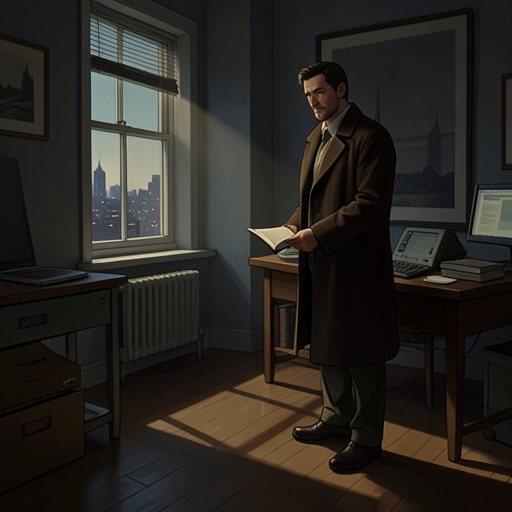
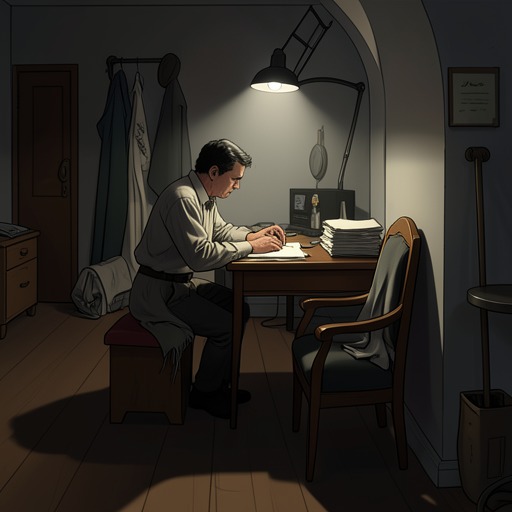
Bénédicte and Reinhardt's first meeting at Nemours
L'Amour et les ForêtsBénédicte and Reinhardt's first meeting at Nemours takes place in March 2008, when a reader's profound response to a novel becomes the basis for an unexpected exchange of confidences. At the Le Nemours café near the Palais-Royal, Bénédicte Ombredanne and Éric Reinhardt discover a striking affinity in their literary imaginations. Yet the encounter is also marked by hesitation and by what each has not said: Bénédicte initially keeps her troubled home life at a distance, while Reinhardt reveals the exhaustion and fear beneath his recent success.
Setting and first impressions
The meeting is the first of two encounters at the café terrace. The second will occur on a Sunday in September, but in this spring meeting both are intimidated, and Reinhardt does most of the talking. Bénédicte has come with questions about how he writes his novels; he steers the conversation toward her, though his efforts to learn what lies behind her descriptions of her life as damaged and herself as abandoned meet with silence.
Their reserve does not prevent an immediate intellectual connection. Bénédicte is an agrégée in French and teaches première classes at a public lycée in Metz. Her master’s thesis was on Villiers de l’Isle-Adam, and she had been delighted to find the short story L’Agrément inattendu among the important references in Reinhardt’s novel. As the two talk, shared points of reference accumulate: Mallarmé, Brigadoon, Médée, Cendrillon, theatre, the Palais-Royal, ecstasy, dance, and lasting love. For Bénédicte, the novel has not merely supplied subjects for conversation; it has recognized a set of longings she already carries.
A shared hunger for wonder
Reinhardt confirms that L’Agrément inattendu expresses his own relation to reality: its harshness makes the possibility of wonder, ecstasy, epiphany, and transformation all the more compelling. Bénédicte says that she too wants such an experience. She has repeatedly imagined herself in the position of Villiers de l’Isle-Adam’s dehydrated wanderer, discovering a hidden way out of ordinary life and descending beneath its surface toward a startling spectacle.
That image gives shape to the distance between Bénédicte’s outward routine and her inward expectations. Each morning, she hopes that some unlikely circumstance might disclose a trapdoor through which she could slip away from the world as it has become: a spectacle that feels insipid and estranged from her. The imagined descent is not simply an escape from daily life. It is a search for her own lost brilliance, for an intensity that could be found within the very depths of present reality. Her reading has recalled that urgency to her, and the conversation lets her name it as a desire for the miraculous in the midst of the ordinary.
The life kept at the edge of the conversation
The first meeting also establishes the limits of Bénédicte’s disclosure. Reinhardt learns that she is married and has two children, a boy and a girl aged seven and fourteen. But she does not explain what has led her to describe her existence as dilapidated or herself as discarded and abandoned. She says little about her husband, and Reinhardt cannot draw out what her situation is. The facts she does share sit beside the language of distress without yet resolving it; her marriage and motherhood are visible, while the circumstances of her unhappiness remain withheld.
The contrast between that reserve and her expansive account of literature is significant. Bénédicte can describe with precision the imagined escape that her reading makes possible, even as she leaves the source of her pain obscure. The encounter therefore offers recognition without yet delivering explanation. Reinhardt understands that her response to his fiction is bound up with a need to recover a self obscured by ordinary existence, but the first meeting only opens the way toward the fuller confidences she will make months later.
Reinhardt’s confession about writing
At the end of their conversation, Bénédicte asks whether Reinhardt has begun another novel. Her question turns the meeting toward the crisis he has not dared to discuss with people close to him. He says he has delayed returning to work, enjoying interviews and bookstore appearances because he cannot imagine matching the happiness he experienced while completing his previous book. Written between October 2004 and March 2007, it had become, in his telling, a consuming, almost final undertaking: he had poured his notebooks, formative sensations, and most intimate thoughts into it, and had imagined the book as a way to spend everything rather than preserve himself in small, cautious portions.
He describes how the work’s initial despair became exhilaration. As he wrote, the fantasy of risking everything gave way to the pleasure of creation; the red Porsche in his account accelerates at 230 kilometres per hour, then becomes a rocket carrying him toward the stars. By the novel’s completion he no longer wanted to die. But the transformation did not last. After publication, he feels emptied of the energy that had sustained the writing and fears that the ordinary writer who remains cannot produce anything half as free or tempestuous. He admits that no one else knows how badly he is doing, including that he cries each morning alone in his office.
Bénédicte listens as he moves between grand, theatrical images of artistic risk and the plain admission of exhaustion. Rather than press him to surpass the book, she tells him not to feel under pressure, says she is eager to read whatever he writes, and urges him to take his time and recover his breath. Her response answers his disclosure with care, as his earlier questions had tried to make room for hers. He also describes a possible next novel about a man in his thirties who lives secluded with his mother and exchanges messages with an exhibitionist couple encountered online; the character becomes determined to interrupt the husband’s deviant arrangement after falling in love with the wife. Bénédicte recognizes a connection to Patrick Neftel, and her interest in the idea reassures Reinhardt without turning into a demand for immediate work.
Significance of the encounter
The first meeting brings together two different forms of vulnerability. Bénédicte speaks of a need to escape the deadening surface of her life, while Reinhardt confesses that the apparent culmination of his creative life has left him frightened and depleted. Their exchange does not solve either difficulty. Instead, it establishes a relation in which literary attention can lead into personal disclosure: Bénédicte’s reading has given Reinhardt a way to speak about the book’s meaning, and her attentive response allows him to say aloud what he has concealed from others.
They part after exchanging kisses on the cheeks. Bénédicte goes down toward the metro, passing beneath the glass beads of Jean-Michel Othoniel’s entrance, on her way to visit a friend. The meeting ends without her explaining the full damage she has hinted at, or Reinhardt finding a way out of his post-novel exhaustion. Its importance lies in the opening it creates: a reader and a writer have recognized one another through a shared longing for a life transformed, while the greater disclosures between them remain ahead.